


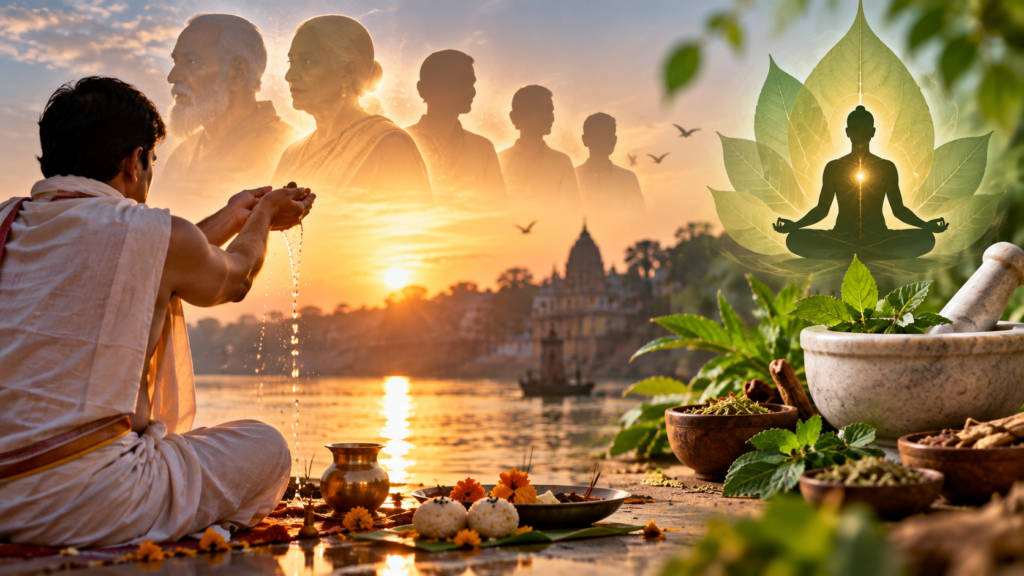
Explore how Pitru Paksha, remembrance, prayer, charity and ancestral rituals can be understood through Ayurveda’s concepts of Sattva, mental balance and emotional well-being.
Pitru Paksha, the traditional fortnight dedicated to remembering and honouring ancestors, is often associated with rituals such as Shraddha, Tarpana, prayer, charity and remembrance. Beyond its religious significance, the period can also be understood through the Ayurvedic concept of mental balance, particularly the cultivation of Sattva—a state associated with clarity, calmness, awareness and emotional stability.
Ayurveda views the mind, or Manas, as an important component of overall health. Classical Ayurvedic thought describes three mental qualities—Sattva, Rajas and Tamas. Sattva is associated with clarity and balance, while Rajas is linked with excessive activity and emotional agitation, and Tamas with inertia and dullness. Ayurvedic literature emphasises the importance of maintaining a balanced mental state.
Remembrance Can Create a Sense of Emotional Connection
One of the central elements of Pitru Paksha is remembering departed family members. For many people, such remembrance provides an opportunity to reflect on family history, relationships, values and personal memories.
From an Ayurvedic perspective, practices that encourage a calmer and more reflective state of mind can be viewed through the broader goal of strengthening Sattva. Ayurveda’s concept of Manas recognises that mental well-being is connected with behaviour, emotions, habits and the individual’s environment.
In this sense, Pitru Paksha can provide a structured period for reflection rather than simply being a series of rituals.
The Role of Shraddha, Prayer and Ritual
Ayurvedic texts describe Daivavyapashraya Chikitsa, broadly translated as spiritual or faith-based therapeutic practices. These include activities such as mantra recitation, listening to sacred sounds, homa, fasting, auspicious observances, offerings and acts of respect. Classical Ayurvedic sources associate such practices with regulation of mental disturbances and the cultivation of Sattva.
This provides an interesting conceptual connection with Pitru Paksha. Rituals such as Tarpana and Shraddha can create a quiet, structured space in which a person pauses from everyday activity, remembers loved ones and expresses gratitude.
The mental benefit, therefore, can be understood not as a claim that a ritual automatically cures stress or anxiety, but as the possible psychological value of reflection, gratitude, devotion and a disciplined routine.
Ayurveda and the Processing of Grief
Ayurvedic literature recognises emotional states such as Shoka (sorrow), fear, anger, attachment and other psychological experiences as important aspects of mental health. Ayurvedic approaches to mental well-being include Sattvavajaya, a form of mind-management aimed at regulating thought and emotional responses.
Pitru Paksha gives families a culturally recognised opportunity to remember people who have passed away. For someone carrying memories of a parent, grandparent or other relative, consciously remembering that person may provide a meaningful space for acknowledging emotions rather than continually avoiding them.
This should not be interpreted as a substitute for professional mental-health care when grief becomes prolonged, overwhelming or disabling.
Sattva, Simplicity and Inner Calm
Another important Ayurvedic idea is that daily habits influence the state of the mind. Practices that encourage moderation, self-discipline, reflection and a calmer lifestyle are consistent with the broader Ayurvedic objective of maintaining balance.
During Pitru Paksha, many families traditionally adopt simpler routines, devote time to prayers and charitable activities, and reduce distractions. Such practices can create an environment conducive to introspection.
Ayurvedic sources describe Sattva as associated with qualities such as knowledge, lightness and mental clarity. Increasing Sattvic qualities is therefore presented as an important aspect of maintaining psychological balance.
Charity and Gratitude
Acts of Daan, or charitable giving, are also commonly associated with ancestral observances. From a broader psychological perspective, gratitude and acts of generosity can shift attention away from purely personal concerns and towards relationships, community and shared values.
In the Ayurvedic framework, spiritual and auspicious practices are included among approaches intended to support the mind.
Thus, the combination of remembrance, prayer, charity and family participation may make Pitru Paksha a period of emotional reflection and social connection.
A Period to Slow Down
Modern life often leaves little time for quiet reflection. Pitru Paksha creates a culturally defined period in which people can temporarily slow down and reconnect with family memories and traditions.
Viewed through Ayurveda, this can be related to the movement from an excessively Rajasic state—characterised by constant activity and emotional stimulation—towards greater Sattva, associated with calmness and clarity. Ayurveda describes Rajas and Tamas as important mental factors and places emphasis on cultivating a balanced mental state.
The Deeper Meaning of Pitru Paksha
The mental significance of Pitru Paksha may therefore lie less in any single ritual and more in the overall experience of remembrance, gratitude, family connection, discipline and reflection.
Ayurveda’s classical framework provides concepts such as Sattva, Daivavyapashraya and Sattvavajaya that help explain why spiritual and reflective practices have traditionally been considered relevant to mental well-being. However, the classical texts do not establish that Pitru Paksha itself is a medical treatment for anxiety, depression or other mental-health conditions.
Ultimately, Pitru Paksha can be seen as a traditional opportunity to pause, remember one’s roots, express gratitude and cultivate inner stillness. In the language of Ayurveda, these practices can be understood as supporting the broader pursuit of mental balance and Sattva.